
Thinking About Contact Lenses? Start With This Complete Guide
A lot of people wear glasses for years, think about contacts now and then and never get round to trying them. Putting something on your eye does sound like a big ask, and what you read online usually either oversells it or scares you off. At Specs Wave, we talk to customers about contacts every week. For most people they work well, provided the fitting, habits and lens itself are right.
Here's what we'd tell any first-time wearer: how contact lenses work, which types are available, where they beat glasses and where they don't, and how to keep your eyes healthy. If you're comparing branded contact lenses or simply trying to understand the basics, this guide is a good place to start. For your own eye care, though, an in-person examination is always the safest next step.
What Are Contact Lenses and How Do They Work?
A contact lens is a thin, curved disc that rests on the tear film covering the cornea, the clear front surface of the eye.
How Do Contacts Work?
It's the same basic idea as glasses: the lens bends light so it lands properly on the retina at the back of your eye. The difference is distance. Glasses sit a centimetre or so from your face, while a contact lens sits directly on the eye. A contact therefore moves with the eye, provides a wider field of view and does not fog or create the same reflections as a spectacle frame.
Because a contact lens sits so close to the eye, a contact lens prescription is not identical to a glasses prescription. It may include adjustments for curvature and fitting requirements that suit your cornea.
Contact Lens Types
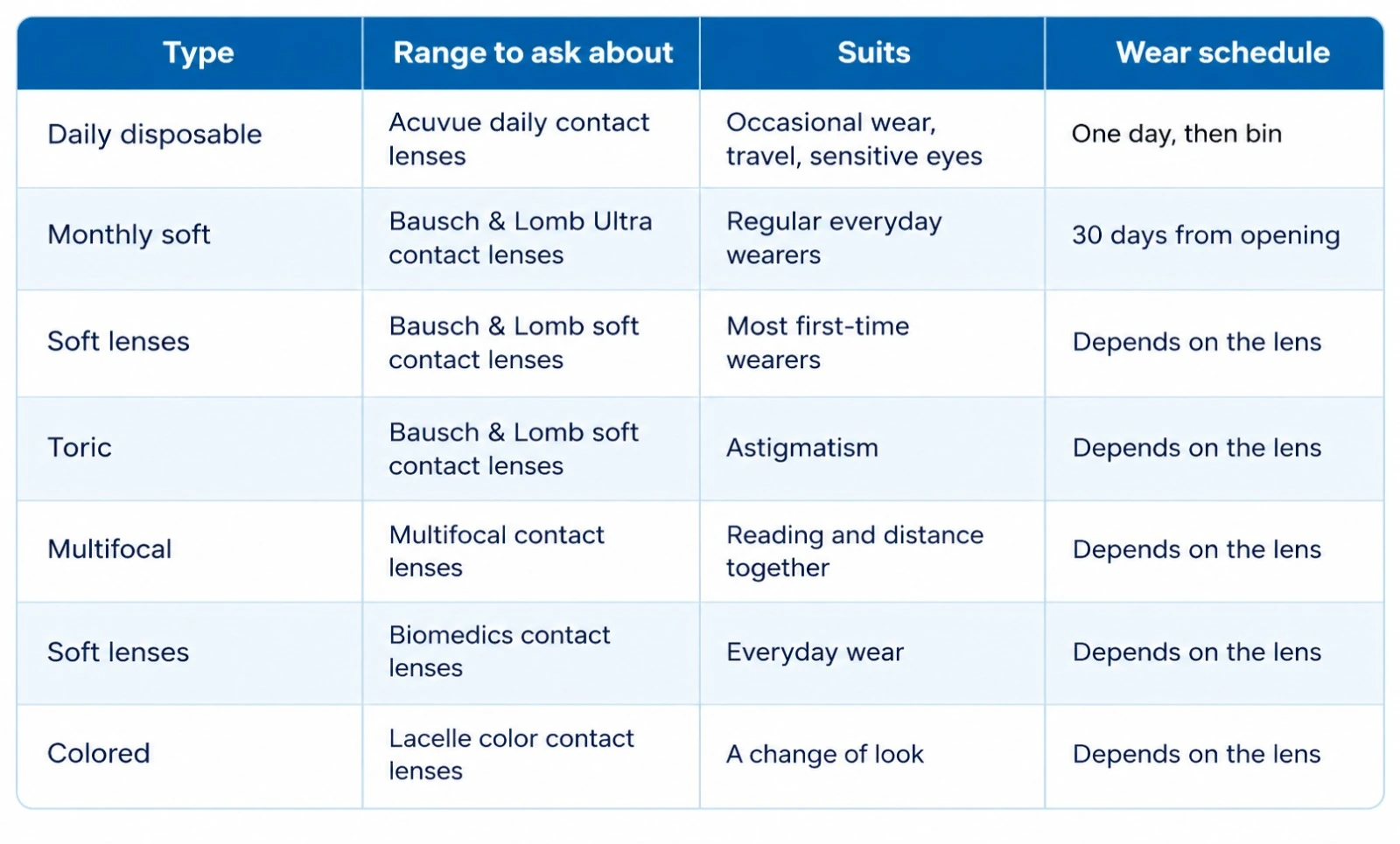
Most people wear soft contact lenses made from hydrogel or silicone hydrogel. These materials allow more oxygen to reach the cornea. Bausch & Lomb soft contact lenses are a familiar example, and several other manufacturers offer similar ranges.
Rigid gas permeable (RGP) lenses are firmer, can provide exceptionally crisp vision and may suit some forms of astigmatism or corneal irregularity. They usually take longer to get used to.
Beyond material, lenses are designed for different prescription needs:
- Spherical lenses: for short sight or long sight
- Toric lenses: for astigmatism
- Multifocal lenses: for both reading and distance vision
- Coloured or cosmetic lenses: for a change of eye colour, with the same fitting and care requirements as clear lenses
Contact Lenses vs Glasses
Are Contact Lenses Better Than Glasses?
Neither option always wins. Contact lenses are useful for sport, travel, outdoor work and situations where a wider, frameless field of view is helpful. Glasses are convenient, may cost less over time and make it easy to give your eyes a break.
Common contact lens drawbacks include dryness and the need for cleaning or careful handling. Disposables reduce the maintenance burden, while wearing glasses during long screen-time days can give your eyes a break.
Choosing Between Contact Lenses and Glasses
It mostly depends on what your week looks like.
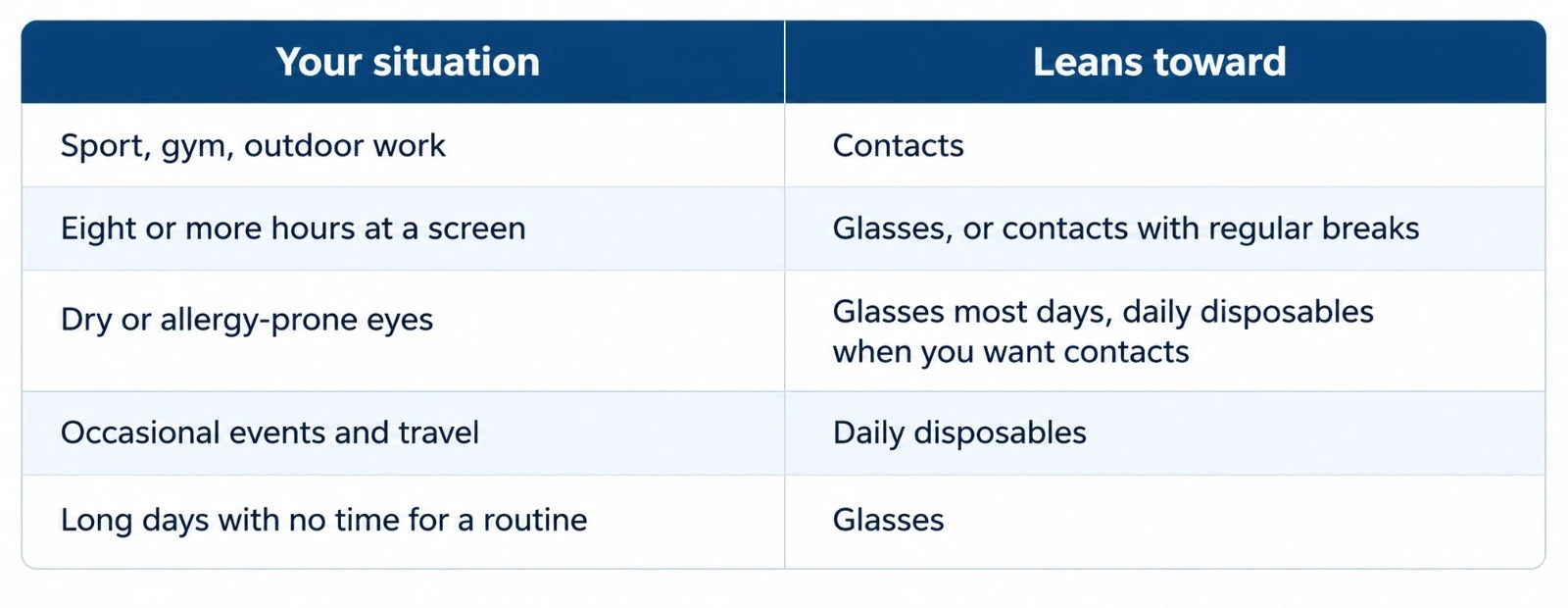
Many people use both: contacts when they need them and glasses at other times. That mix can also make eye care easier.
Are Contact Lenses Safe for Your Eyes?
Are Contact Lenses Safe for Daily Use?
Yes, when they are fitted properly and looked after. Contact lenses remain medical devices, however, so they should not be treated like an ordinary fashion accessory.
A 2017 systematic review in the *Journal of Ophthalmic and Vision Research* found that complications range from simple discomfort to sight-threatening problems. Proper handling helps people wear lenses comfortably. Eye care professionals also identify sleeping in lenses, skipping hygiene and ignoring early warning signs as major avoidable risks.
Who Cannot Wear Contact Lenses?
Some conditions make contact lenses a poor choice, at least for now. These include an active eye infection or inflammation, severe untreated dry eye, uncontrolled allergies and certain corneal conditions.
But “cannot” may mean “not yet.” Dry eye can often be treated before lenses are tried again, sometimes with dailies. Keratoconus or another irregular corneal condition may require specialist RGP or scleral lenses rather than standard lenses. Only a comprehensive eye examination can determine what is appropriate for you.
Can You Sleep With Contacts in?
Do not sleep in contact lenses unless an optometrist has specifically prescribed lenses approved for overnight wear. Sleeping in lenses reduces oxygen to the cornea and increases infection risk, even with modern silicone hydrogel materials.
If you accidentally fall asleep with lenses in, remain calm. On waking, add a few drops of saline or rewetting drops until the lens moves freely, then remove it. Wear glasses for the rest of the day and watch for redness or pain.
Choosing the Right Contact Lenses
Daily, Monthly and Other Options
- Daily disposable lenses are worn once and discarded. They require no solution or reusable case, making them convenient for occasional wear, travel and allergy-prone eyes. Acuvue daily contact lenses are one commonly requested option.
- Monthly lenses, such as Bausch & Lomb Ultra, cost less per day for regular wearers but require cleaning and storage every night.
- Two-weekly lenses sit between daily and monthly lenses.
- Toric, multifocal and coloured lenses are available across many of these replacement schedules.
People who buy contact lenses in Hassan often assume monthly lenses are always cheaper. For daily wear, they usually are. But if you only wear contacts a few times per week, dailies may be better because a monthly lens must be replaced after 30 days whether or not it was worn every day.
How Often Should Contact Lenses Be Replaced?
Follow the schedule printed on the package. Dailies go after one day, two-week lenses after 14 days and monthly lenses after 30 days from opening. Older lenses accumulate deposits and allow less oxygen through, increasing dryness and itching.
Replace your lens case every three months. Discard any lens that is torn, chipped or dropped onto an unclean surface. If cost is encouraging you to over-wear lenses, speak to your optometrist about a lower-cost replacement schedule.
How Long Can Contact Lenses Be Worn in a Day?
Most optometrists recommend around eight to ten hours, although the appropriate duration depends on your eyes and the lens. If you are new to contacts, begin with a few hours and gradually increase wearing time according to your follow-up plan.
Discomfort or dryness in the evening means the lenses may be worn for too long. Switch to glasses, use rewetting drops and speak to your optometrist if the problem continues.
What Happens at a Contact Lens Fitting?
Good lenses require a proper eye examination. An optometrist assesses your prescription, corneal shape, tear film quality and the front surface of the eye. Trial lenses may be used, followed by a review of comfort and vision.
This is where avoidable fitting issues are detected. Premium contact lenses can offer more advanced materials, oxygen transmission and options for eyes that do not tolerate standard lenses.
Which Contact Lenses Suit You?
Astigmatism and Toric Lenses
Astigmatism means the front of the eye is shaped slightly more like a rugby ball than a football. Light does not focus evenly, and vision may swim when the lens rotates.
Bausch & Lomb toric contact lenses are designed to stay in the correct position. Fitting requires more care than standard single-vision lenses, so it should be done by an optometrist rather than guessed from a prescription.
Reading Vision and Multifocal Lenses
From around the forties, near focus often becomes harder. Multifocal contact lenses combine distance and near correction in one lens, reducing the need to switch between pairs of glasses.
They can take several days to adjust to, and the visual experience may differ from single-vision lenses. During the trial period, describe what you read and look at most often so the prescription can be refined.
Coloured Contact Lenses
Coloured contact lenses can provide a noticeable change of appearance. Lacelle colour contact lenses are one option we are often asked about.
Even lenses with no power require a proper fitting. Never share them, and maintain the same hygiene as with clear lenses. Cosmetic lenses purchased online or in stores without fitting can cause serious complications.
Types and Brands at a Glance
How to Wear Contact Lenses
Nerves are normal. The first few tries feel awkward for almost everyone.
How to Insert Soft Contact Lenses
- Wash your hands with soap and dry them with a lint-free towel.
- Rinse the lens and place it on your fingertip. Check that it is the correct way around. The edge should curve upward like a bowl, not flare out like a saucer.
- Look upward or directly ahead. Gently lift the upper eyelid with one finger while pulling down the lower lid with the other.
- Place the lens on the eye, release the lids and blink slowly.
- If it feels uncomfortable straight away, remove it and check for debris or an inside-out lens.
How to Remove Contact Lenses
Wash and dry your hands. Look upward and gently move the lens to the white area of the eye using clean fingers. Avoid nails, tweezers or force.
If a lens feels sticky, do not pull it. Blink for a moment and add several drops of saline or rewetting drops so it can move freely.
Getting Used to Contacts in the First Two Weeks
It is common to notice a lens during the first few days. Follow the wearing schedule and attend the follow-up appointment. If you are receiving your first pair from a contact lens store in Tumakuru or another city, book the follow-up in advance. It is the best time to correct minor fitting issues before they become habits.
Contact Lens Care and Hygiene
What Is the 3:1:1 Rule for Contacts?
The 3-1-1 rule is an airport liquids rule, not a contact lens hygiene rule. It allows containers of 100 ml or less in one clear bag, with one bag per passenger. The rule began with US airport security and is used at many international airports. Lens solution counts as a liquid.
Take extra pairs in hand luggage, pack travel-sized solution and check your airline's policies before flying. Always carry a spare pair of glasses and a spare lens case.
How to Keep Contact Lenses Clean and Comfortable
- Wash and dry your hands before handling lenses.
- Clean reusable lenses with the recommended solution; never use tap water or saliva.
- Use fresh solution every time rather than topping up old solution.
- Air-dry the lens case face down and replace it every three months.
- Keep lenses away from showers, pools and the sea.
- Apply makeup after inserting lenses and remove it before taking lenses out.
Common Contact Lens Concerns and Solutions
How Can You Make Contact Lenses More Comfortable?
Dryness is a common concern and is often manageable. A different material or a move to daily disposable lenses can help. Routines that support comfort include:
- Using rewetting drops recommended for contact lens wear
- Blinking fully and frequently during computer use
- Keeping fans or air-conditioning away from the face
- Drinking enough water
- Taking some days off from lenses each week
If dryness persists, have the lenses refitted rather than enduring discomfort.
What Should You Do If Your Eyes Feel Uncomfortable While Wearing Contacts?
Remove the lens immediately. Rinse it and check that it is undamaged, correctly oriented and free of debris. If the lens is clean and the eye is comfortable after removal, you may try a replacement lens as advised by your optometrist.
Redness that does not settle, pain, sensitivity to light, blurred vision or discharge requires urgent attention. Stop wearing the lenses, use glasses and see an optometrist the same day.
Visit Specs Wave for Contact Lenses and Eye Care
Lenses are better selected in person after a proper examination than guessed at online. Our stores are open daily from 10 AM to 9 PM, and certified optometrists handle eye examinations at every location.
At Specs Wave Tumakuru, inside Krishna Arcade on General Cariappa Road in K R Extension, call +91 83104 34094.
At Specs Wave Hassan, on Shankar Mutt Road in Krishnaraja Pura, call +91 8172450094.
At Specs Wave Chikkamagaluru, on MG Road opposite the Sri Vasavi Kannikaparameshwari Temple, call +91 8262451213.
Our stock includes Bausch & Lomb, Acuvue, Biomedics and Lacelle, along with solutions and everyday lens care essentials. Ask our team which options suit your prescription and budget.
Final Thoughts
Contact lenses work best for people who look after them. Get a proper fitting, follow the replacement schedule, keep hands and cases clean and never sleep in lenses unless prescribed. With those habits, most of the problems people worry about can be avoided.
If you are curious but unsure, visit Specs Wave Tumakuru, Specs Wave Hassan or Specs Wave Chikkamagaluru. Our teams will be happy to answer questions before you decide anything.
Contact Lens FAQs
Can You Wear Contact Lenses Every Day?
Yes, if the fit is right, the replacement schedule is followed and hygiene is good. It is also helpful to give your eyes time without lenses, wear glasses in the evening and attend annual eye examinations.
Can You Switch Between Contact Lenses and Glasses?
Absolutely. Keep both prescriptions current because a glasses prescription is different from a contact lens prescription. After a full day in lenses, using glasses for a few hours can give the eyes a break.
When Should You Replace Your Contact Lenses?
Replace them according to the exact schedule on the package or prescribed by your optometrist. Never stretch a monthly or two-week lens simply to save money. Replace a reusable lens case every three months as well.
Are Daily Disposables Better Than Monthly Lenses?
Not necessarily. Daily lenses are convenient and may suit dry or allergy-prone eyes because there is no cleaning. Monthly lenses cost less per day when worn regularly. If you use lenses only a few times per week, dailies may work out better economically.
Can You Wear Coloured Lenses With a Prescription?
Yes. Coloured lenses are available with vision correction and without power. They still require a proper fitting, and available colours may vary for stronger prescriptions.


