
How Modern Eyeglass Lenses Are Built for Driving: A Guide to Premium Driving Glasses
A lens that works perfectly for reading a menu can feel oddly poor on a highway at 8 pm. Headlights streak. The dashboard throws a faint second image into the glass. Lane markings on wet tarmac seem to wobble.
That gap is what premium driving glasses are meant to close. If you're considering a premium driving glasses store to help you choose the right eyewear, it's worth understanding that driving glasses aren't one gadget or a special tint. They're a stack of decisions: the prescription, the lens design, the coating, the tint and the fit. Get those right and night drive glasses stop being a gimmick and start earning their place on your dashboard.
This guide explains how each layer functions, where the marketing gets ahead of the science and how to deal with the tricky parts. If there is a flaw in a particular feature, we point that out and then tell you how to make the best of it.
What causes glare and halos at night?
Night-time glare and halos occur because pupils dilate in darkness and allow light through the outer portions of the eye's optics, where vision is less sharp. Bright headlights can scatter in the eye. Small errors, such as mild astigmatism, may show up as streaks or rings around lights.
Your eyes don't behave the same way at 8 pm as at noon. Three things change together.
What pupil dilation does to your focus
Pupil size is quite small during daytime hours. The pupil functions much like a camera stopped down, where light passes through only the sharp center of the cornea and lens. Once night sets in, the pupil expands, allowing light to pass through areas that are not as accurately curved as the center.
A tiny refractive error that goes unnoticed during the lunch hour can suddenly become apparent once you hit the road after dinner time.
Night myopia
Some eyes also drift slightly towards short-sightedness in dim light. The shift is usually small, but small is enough to make a road sign look fuzzy. The Cleveland Clinic notes that people with night myopia see worse after dark, particularly when their prescription is out of date.
If you read the chart fine at your eye test but struggle after sunset, say so. Your optometrist can look into it rather than assuming everything is fine.
Why LED and high-beam headlights feel harsher
Many modern LED headlights can appear brighter than the halogen lights that were common when we were growing up. Shorter wavelengths of light disperse more easily within the eye, so there can be more haze in your field of vision.
Add a truck with its high beams on and that haze can last even longer. Your ability to recover from glare decreases with age, and conditions such as cataracts can exacerbate that effect.
What actually makes a lens a good driving lens?
Four things do the heavy lifting: an accurate prescription, a well-designed lens surface, a good coating and a tint that suits your driving hours. A weakness in any one can show up on the road.
Start with the prescription
No amount of coating will save a drifting prescription. Driving at night can reveal subtle differences, which means an updated prescription is the largest single factor a driver can improve. According to the Cleveland Clinic, annual eye tests should be carried out starting from the age of 40 because of the changes that come with age.
At your appointment, let the optometrist know where and when you drive. Dusk driving on a highway is not the same as driving a couple of times during the day within town limits.
Lens design and fit
Older lenses had a standard curvature and functioned fine in the center region. Digitally surfaced lenses used by top brands like ZEISS, Essilor, Hoya and Rodenstock are designed according to your prescription and frame. The intention is to have a broad area of sharp vision with less blurring on the sides. This is important every time you look into your side mirrors.
The accuracy of such calculations depends on the precision of the measurements taken. In our stores, we utilize the ZEISS i.Terminal to measure vertex distance, pantoscopic tilt and wrap angle. These are the little numbers that determine how your frame fits on your face. Even a lens off by a few millimeters from the optimal point may seem very "off", and drivers usually notice first.
Are anti-glare lenses good for night driving?
Yes, for most drivers. An anti-reflective coating reduces reflections from the front and back of the lens, so more light reaches your eye and halos around car lights can shrink. One optometry guide puts light passing through at about 99.5% with coating, against roughly 92% without.
This would be our first recommendation when looking at night drive glasses. A multi-layer coating like that used by Essilor in its Crizal line is also designed to resist scratches and smears. This is important when driving, since an oily fingerprint reflects headlight beams just as effectively as a dirty windshield.
Coatings become increasingly important with higher prescriptions. High-index lenses reflect more light and therefore benefit more from the coating than regular plastic lenses.
Coated lenses are very clear, so smears or dust are noticeable. Store a microfiber cloth in the car, clean off dust before wiping and avoid wiping with shirts and tissues, which can scratch lenses.
Anyone searching for the best driving glasses shop in Tumakuru will see a lot of talk about tints and special colours. We'd ask about the coating first. Highway stretches with fast trucks and high beams are exactly where reflection control pays off.
Do night driving glasses work?
Yellow-tinted night driving glasses haven't shown a measurable benefit in research. A 2019 JAMA Ophthalmology simulator study with 22 adults found no faster pedestrian detection and no reduction in headlight glare effects compared with clear lenses. A good coating and an accurate prescription are better supported.
The study, summarised in the American Academy of Ophthalmology's EyeNet, used three commercial yellow lenses and tested them against clear glasses. The authors said it was hard to recommend the lenses for poor night vision.
That doesn't mean everyone who likes them is imagining things. A few drivers feel more relaxed behind a warm tint and the Cleveland Clinic calls them harmless to try. We'd just sort out the prescription and the coating first. If you're looking to buy the best night driving glasses you can find, that's where the money works hardest.
Polarised and tinted lenses: made for daylight
Grey and brown shades are normally selected during the daytime. This helps reduce light without distorting colours, so traffic signals still appear as traffic signals. Polarised lenses, introduced by Polaroid, reduce glare from wet roads, bonnets and water surfaces.
They don't suit night driving. Any dark lens reduces the little light you already have, so take sunglasses off at dusk and before tunnels or long underpasses.
Some digital dashboards and phone navigation screens can look dim or patchy through polarised lenses, so check your own car's display and phone mount with the lenses on before you buy.
Can you drive comfortably in progressive lenses?
Yes. Plenty of drivers over 40 wear progressives such as the Varilux range, so one pair covers the road, the dashboard and the phone.
The edges may seem rather swimmy for a while, and this can be quite scary when your first big drive is also your first time wearing them. Put them on and walk around the house for a couple of days before attempting to drive anywhere, or try them in an empty parking lot. Turn your head and look in a mirror rather than shifting only your gaze.
Most people settle quickly. If you don't, tell us. Fitting height is a common reason for lingering trouble and it can be corrected.
ZEISS DriveSafe lenses
ZEISS DriveSafe is a lens range designed around driving, and it is available at Specs Wave. It comes in three designs:
- DriveSafe Single Vision: for drivers who need one distance correction.
- DriveSafe Progressive: for drivers who need distance and close-up vision. It is built around the distance and intermediate zones, which cover the road, the mirrors and the dashboard, while the near zone handles a phone or a map.
- DriveSafe Individual: a progressive design personalised with extra face and frame measurements, taken with the ZEISS i.Terminal in our stores.
ZEISS adds its DuraVision Plus DriveSafe coating, which is meant to reduce glare from oncoming headlights and streetlights. Its Luminance Design technology takes pupil size into account, so the lens is tuned for both bright and dim light. A tint and polarisation option is available for daytime driving.
ZEISS reports from its own trials that 64% of participants felt less discomfort glare than with its premium anti-reflective coating. That is the manufacturer's figure, not an independent one, so the best test is to try the lenses yourself. Ask our optometrist which design suits the way you drive.
Do photochromic lenses work inside a car?
Often only partly. Photochromic lenses are triggered mainly by UV light and modern windscreens block most of it, so standard versions darken less inside a car than outdoors.
But they do serve their purpose. On hilly roads of Chikkamagaluru, where trees prevent constant exposure to sunlight, adaptive lenses can be very useful.
Which lenses react to visible light? Have a look at your photochromic lenses inside a vehicle before buying them. Some people find it more convenient to have regular lenses and prescription sunglasses separately.
Which lens suits which situation?
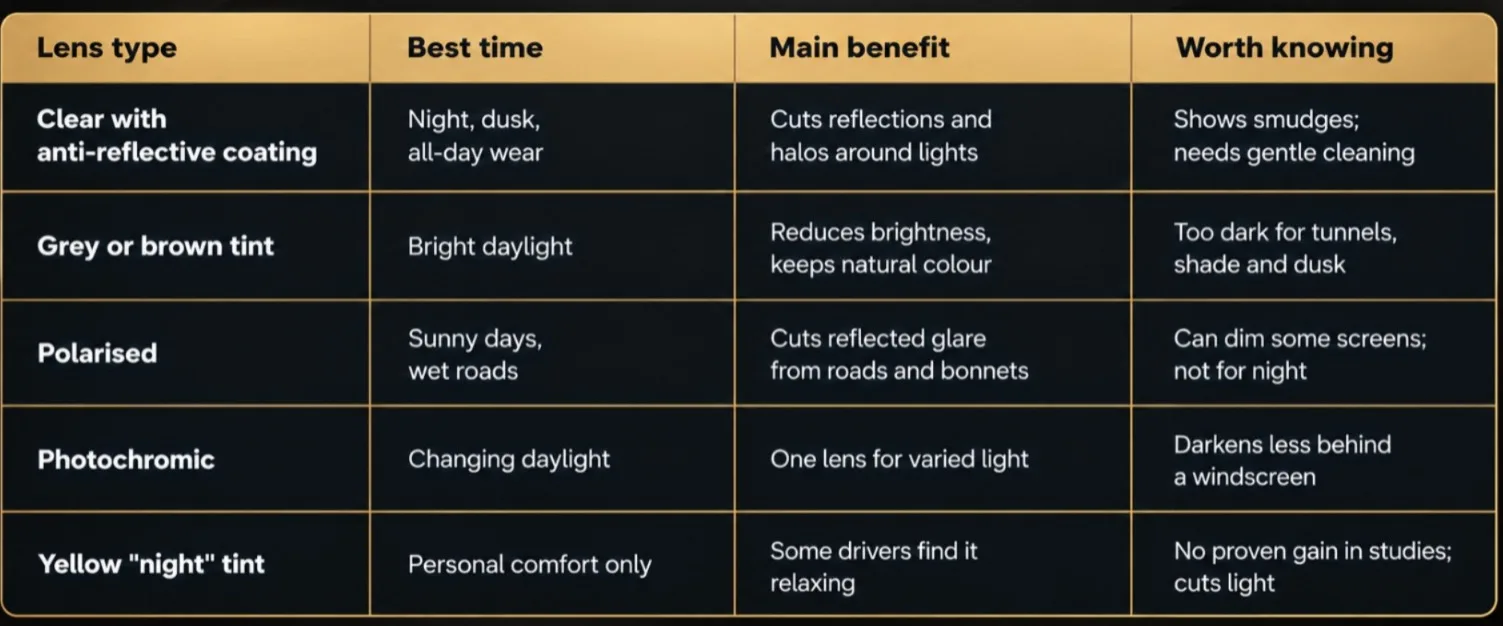
Which driver are you?
Your routine decides the right setup better than any brand name. If you want to buy the best night driving glasses for your own situation, start here.
- The highway commuter. Long, fast drives with truck high beams call for a current prescription and a top-quality anti-reflective coating. Add tinted or polarised glasses for the daytime leg.
- The dusk-hours driver. You hit the worst light of the day twice. Clear coated lenses stay with you from sunset onwards and a separate sun pair covers the glare earlier.
- The hill-road driver. Bends, mist and rain test contrast. Think of a good coating, a pair that fits snugly and perhaps photochromic lenses for sun and shade. Anyone comparing the best driving glasses shop in Chikkamagaluru should mention the roads first.
- The over-40 progressive wearer. Ask for a driving-friendly progressive design, such as ZEISS DriveSafe Progressive, with careful fitting height, plus an anti-reflective coating. Give yourself a week to adapt.
- The occasional city driver. Everyday glasses with a good coating are probably enough. A second dedicated pair isn't essential unless you start driving after dark more often.
What to ask your optician
A good optician won't mind questions. Take this list along.
- Is this lens digitally surfaced for my frame and prescription?
- How were my fitting measurements taken?
- What kind of anti-reflection coating is this and how does it deal with scratches and fingerprints?
- Am I able to see the coating and tints through the windows of the car, or at least in bright conditions?
- How long is the adaptation period and what will happen if I’m still not comfortable during that time?
- Will this be suitable for night driving, day driving, or both?
If you're comparing options for the best driving glasses shop in Hassan, these questions show quickly how a premium optical store works. You'll learn more from the answers than from any price tag. We'd rather you ask them at our counter than wonder about them in the car.
Small habits that help, whatever glasses you wear
Lenses can only do so much and the rest is housekeeping.
- Clean both sides of your windshield.
- Even thin layers of dirt scatter light excessively, especially during nighttime drives.
- Reduce the brightness of your dashboard lights.
- Position your mirrors correctly to minimize any reflections.
- When another car with high beams approaches, look towards the left side of the road instead of the lights.
Additionally, observe whether there is an increase in the occurrence of such symptoms. Your symptoms will not be helped even by changing into new eyeglasses. The problem may be due to cataracts, dry eyes or other conditions. Eye care must be viewed through the lenses of the eyes, not separately.
Visit a Specs Wave store
Our premium optical store showrooms are open daily from 10 AM to 9 PM and walk-ins are welcome. Each store offers a full eye test with certified optometrists, ZEISS i.Terminal fitting measurements and on-site lens fitting.
- Tumakuru: Ground floor, Krishna Arcade, General Cariappa Road, K R Extension, Tumakuru 572101
- Hassan: Ground floor, 198/A, Shankar Mutt Road, Krishnaraja Pura, Hassan 573201
- Chikkamagaluru: Ground floor, 199, MG Road, Chikkolale, Lakshmishanagara, Chikkamagaluru 577101
Call us on +91 83104 34094, message us on WhatsApp at +91 93535 44055, or book a visit through Specs Wave. Bring the glasses you drive in now and tell us about your usual routes. We'll take it from there.
Choosing with some confidence
There is no one element that defines good driving glasses. It is the combination of having an up-to-date prescription, a good lens design, a coating that reduces reflection, a colour that suits the time of day and a well-fitting frame. When there is an element that has a downside, a slight change in behaviour can solve it.
Frequently asked questions
1. What are premium driving glasses?
Premium driving glasses are glasses built with road use in mind. They comprise an accurate prescription, accurate lens manufacturing, a quality anti-glare coating and suitable tinting during the day. The objective is clear and comfortable vision in different light conditions and while spending time driving.
2. How do I buy the best night driving glasses?
Begin by having an eye examination, choose quality lenses with an anti-reflective coating and have them fitted properly. You should avoid using dark tinted lenses for night driving. Ask to view the lenses with bright lights and check that you can see your phone and dashboard with them.
3. Should I buy a separate pair just for driving?
It's worth it if you drive often, use highways or drive after dark regularly. A dedicated pair can be tuned to distance and dashboard vision. Occasional city drivers may be fine with everyday glasses that have a good anti-reflective coating.
4. Are yellow-tinted glasses good for night driving?
Glasses with yellow-tinted lenses do not improve headlight glare or pedestrian visibility at night. Clear lenses with an anti-glare coating are a better-supported choice.
5. Are polarised sunglasses suitable for driving?
Polarised glasses assist in reducing glare from roads and car surfaces during daytime when the sun is shining brightly. They should not be used when driving at night, and some dashboard and smartphone screens may appear dark through them.


